Two-body decaying dark matter
Description
TBDemu is an emulator implementing a nonlinear response of two-body decays within the dark matter. The phenomenology of two-body decaying dark matter (2bDDM) is based on two parameters: the decay rate \(\Gamma\) (in 1/Gyr) and the magnitude of velocity kicks obtained by decay products \(v_k\) (in km/s). Additionally, one can assume only a fraction of decaying dark matter \(f\) in the total dark matter abundance: \(f=\Omega_{\rm m, decaying}/\Omega_{\rm m, total}\). The TBDemu emulator is built on gravity-only \(N\)-body simulations run by Pkdgrav3 code [1]. The emulator predicts
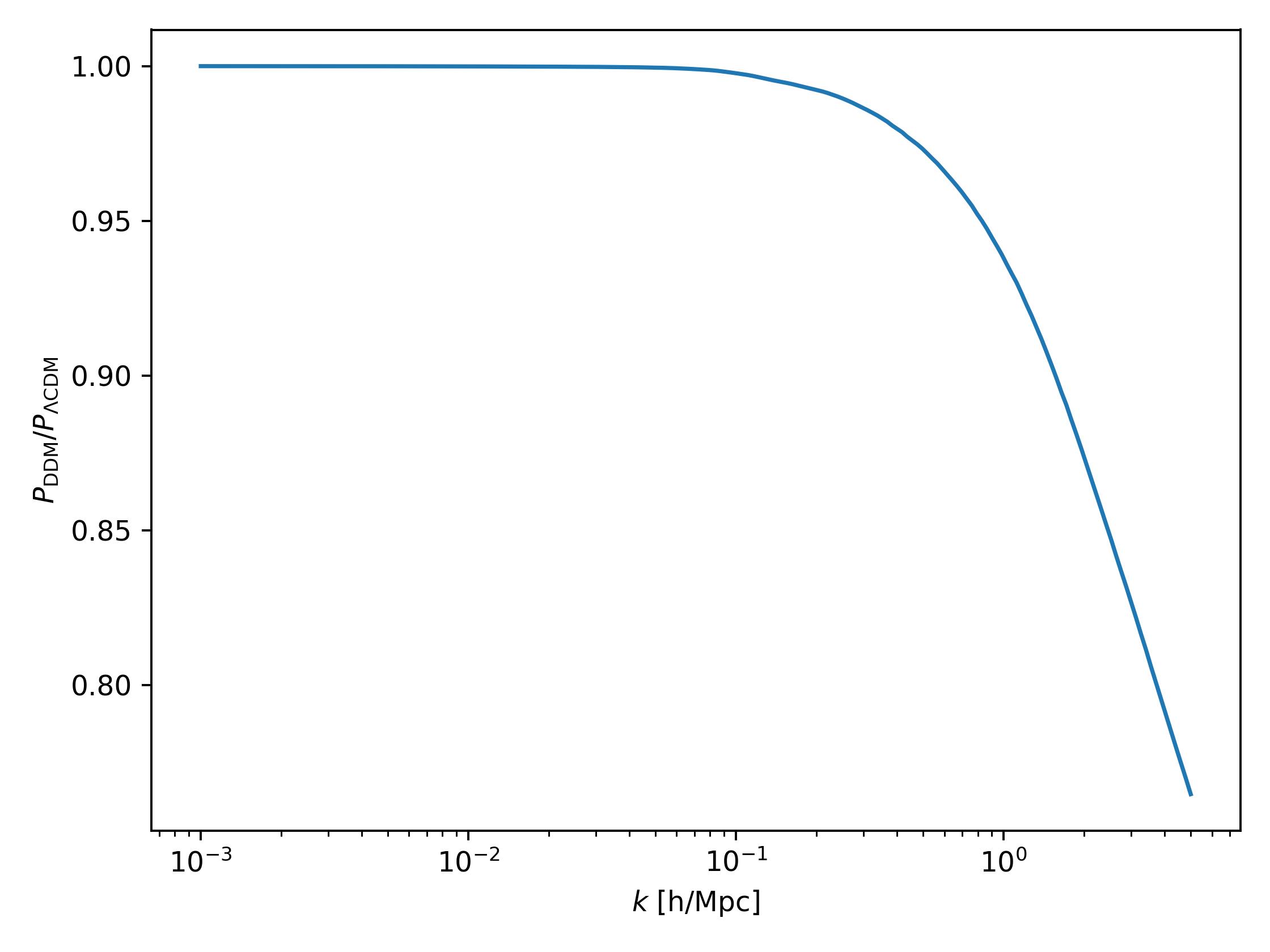
thus a ratio of nonlinear matter power spectrum in the scenario including dark matter decays and (nonlinear) \(\Lambda \rm CDM\) matter power spectrum. For more details, see Ref. [2]. The emulator was trained using Sinusoidal representation networks (SIRENs) [3].
Quickstart
import numpy as np
import DMemu
import matplotlib.pyplot as plt

# load emulator
emul = DMemu.TBDemu()

# predict suppressions between kmin and kmax for a single redshift
kmin = 1e-3 # in h/Mpc
kmax = 5 # in h/Mpc
ks = np.logspace(np.log10(kmin),np.log10(kmax),200) # scales
zs = 0.0 # redshift
velocity_kick = 500 # in km/s
gamma_decay = 1/50 # in 1/Gyr
fraction = 1.0

pks = emul.predict(ks,zs,fraction,velocity_kick,gamma_decay)

# plot
plt.semilogx(ks,pks)
plt.xlabel(r'$k$ [h/Mpc]')
plt.ylabel(r'$P_{\rm DDM}/P_{\Lambda \rm CDM}$')
plt.tight_layout()
plt.show()
Parameter space
decay rate: \(\Gamma \in [0,1/13.5]\) Gyr \(^{-1}\)
velocity kick magnitude: \(v_k \in [0,5000]\) km/s
fraction of 2bDDM: \(f \in [0,1]\)
scales: \(k < 6\) h/Mpc
redshifts: \(z < 2.35\)
Input format of \(k\) and \(z\)
Single value of \(k\) and \(z\):
k = 0.10 # in h/Mpc
z = 0.0
pks = emul.predict(k,z,fraction,velocity_kick,gamma_decay)
Provides a single suppression value.
Single value of \(z\) for multiple scales \(k\):
k = np.logspace(-2,0,10) # in h/Mpc
z = 0.0
pks = emul.predict(k,z,fraction,velocity_kick,gamma_decay)
Provides a list of suppressions at desired scales for a single redshift \(z\).
Single value of \(k\) for multiple redshifts \(z\):
k = 0.10 # in h/Mpc
z = np.array([0.0,1.0,2.0])
pks = emul.predict(k,z,fraction,velocity_kick,gamma_decay)
Provides a list of suppressions at a given scale for all redshift values \(z\).
Multiple scales \(k\) for multiple redshifts \(z\):
k = np.array([0.1,0.5,1.0]) # in h/Mpc
z = np.array([0.0,1.0,2.0])
pks = emul.predict(k,z,fraction,velocity_kick,gamma_decay)
The above code provides three suppression values, first for \(k=0.1\) and \(z=0.0\), second for \(k=0.5\) and \(z=1.0\) and last for \(k=1.0\) and \(z=2.0\). The code checks that the lengths of both array are equal.
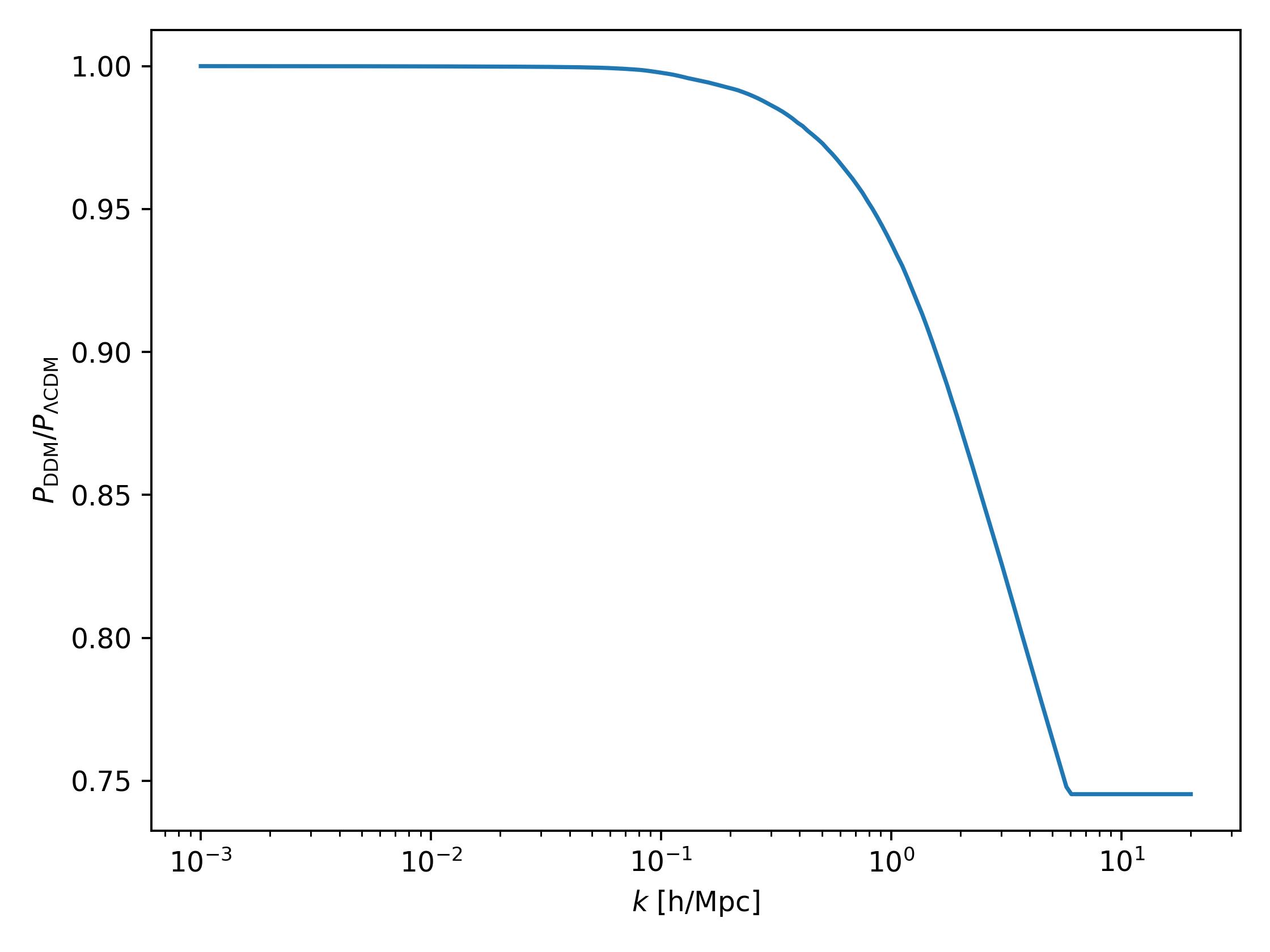
Extrapolation
Extrapolation for \(\Gamma\), \(v_k\), \(f\) and \(z\) is not allowed as the trained architecture cannot reliably predict outside the training domain. Extrapolation for \(k>6\) h/Mpc is done by adding a constant suppression continuously attached to the one provided by an emulator, see the figure below. However, one can ask for redshifts higher than 2.35 by setting allow_z_extrapolation=True in TBD.predict(...) function.